

The new DGUV accident statistics are now available online. We highlight the trends and key figures. There were fewer reportable workplace accidents, more commuting accidents, and a slight decline in new accident pensions, while the total number of fatal accidents rose again.
DGUV: Preliminary accident figures for 2025 paint a mixed picture
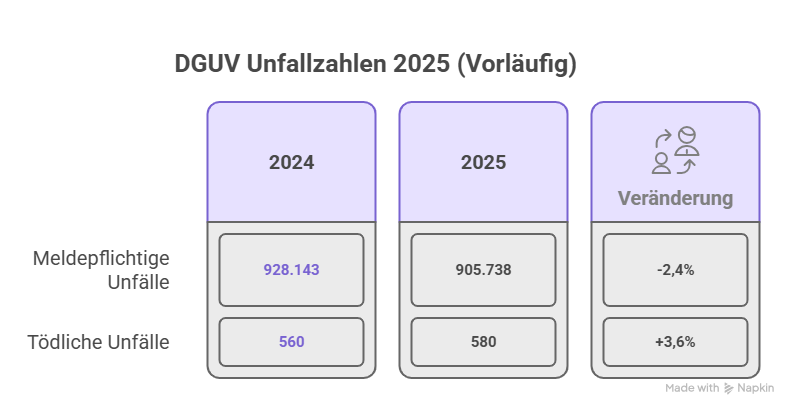
The latest preliminary accident figures from the DGUV for 2025 paint a mixed picture: Overall, reportable accidents under general accident insurance declined from 928,143 to 905,738—a decrease of 22,405 cases, or 2.4 percent. At the same time, fatal accidents rose from 560 to 580, an increase of 20 cases, or 3.6 percent.
The trend in workplace and commuting accidents is particularly striking. Work-related accidents fell significantly from 754,660 to 730,598, representing a decrease of 24,062 cases, or 3.2 percent. Commuting accidents, on the other hand, rose slightly, from 173,483 to 175,140 cases—an increase of 1,657, or 1.0 percent.
What the numbers reveal in detail
The decline in workplace accidents is particularly evident among the industrial workers’ compensation associations: there, the number fell from 684,352 to 661,414—a decrease of 22,938 cases, or 3.4 percent. Among public-sector accident insurance providers, the decline was slightly smaller at 1.6 percent, from 70,308 to 69,184 cases.
The situation is different for commuting accidents: Here, the DGUV reported an increase in both the private sector and the public sector. The increase was particularly sharp among public-sector employers, with commuting accidents rising from 25,448 to 26,273—an increase of 825 cases, or 3.2 percent.
The total number of new accident pensions declined slightly, from 13,470 to 13,326 cases—a decrease of 144, or 1.1 percent. For work-related accidents, this number fell by 233 to 9,690 cases, while the number of new pensions for commuting accidents rose from 3,547 to 3,636 cases.
Classification of Trends
The decline in reportable workplace accidents is a positive sign. It suggests that preventive measures, safety training, and workplace safety plans are having an effect. However, this trend should not obscure the fact that fatal commuting accidents have increased significantly, particularly in the public sector, where the number rose from 21 to 32 cases.
In practice, this means that traditional workplace safety remains important. However, the commute to work is becoming an even greater focus. Traffic hazards, fatigue, weather conditions, and time pressure, in particular, are typical factors that can lead to serious consequences on the way to or from work.
What Companies Should Take Away From This
Companies should not limit their prevention efforts to the workplace alone. They should also place greater emphasis on safe behavior during the commute to and from work. This includes, for example, guidance on defensive driving, driving in accordance with weather conditions, and allowing realistic time buffers for the start of the workday and shift changes.
Even as the number of workplace accidents declines, the absolute figure remains high: More than 730,000 reportable workplace accidents in a single year show that workplace safety remains a constant priority. Therefore, effectively preventing accidents requires not just isolated measures, but a consistent culture of safety in everyday work.